
Introduction
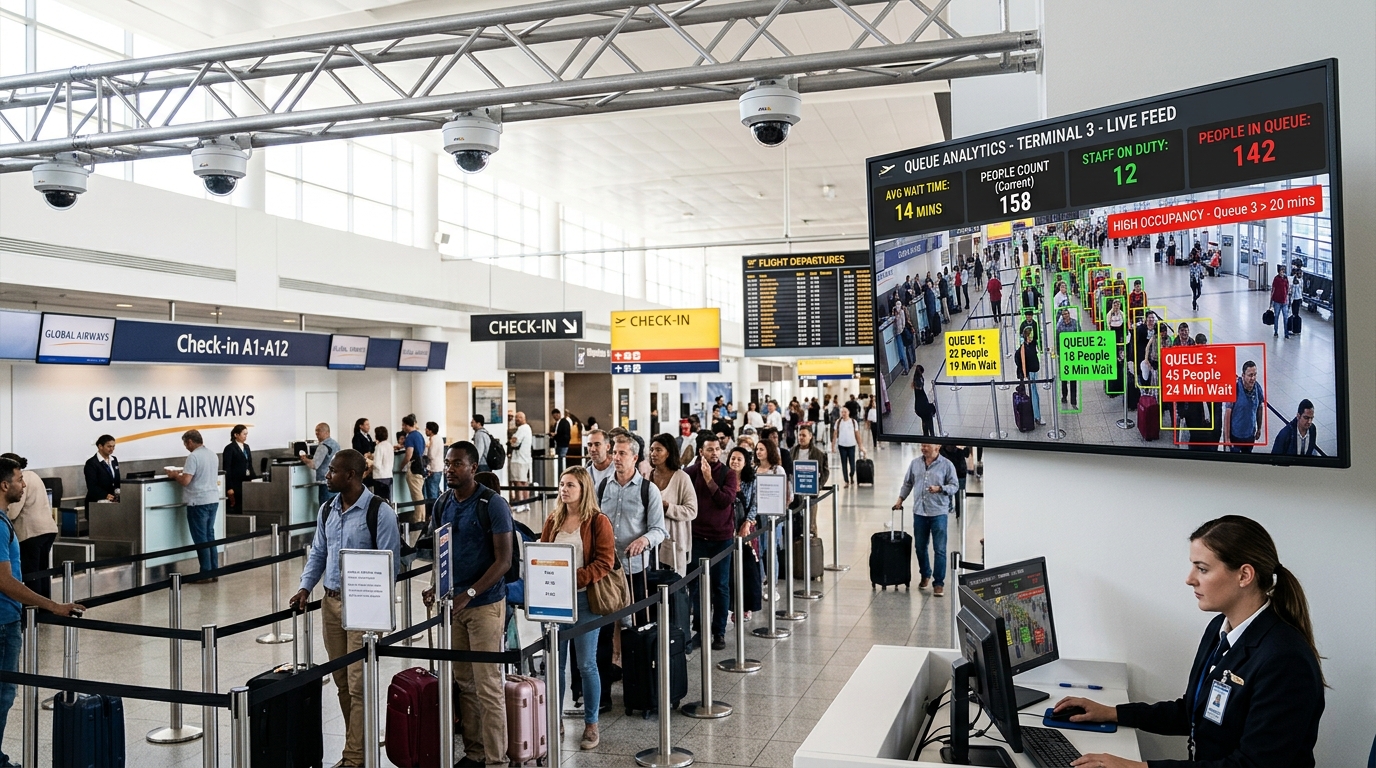
Businesses today face increasing pressure to reduce customer wait times while maintaining high service quality. Traditional manual monitoring methods are no longer sufficient in fast-paced environments such as retail stores, banks, hospitals, and transportation hubs. This is where Queue Detection Software analytics becomes essential, enabling organizations to automatically interpret live camera feeds and turn them into actionable operational data.
By analyzing customer movement patterns, service delays, and congestion points, companies can make smarter staffing decisions and improve overall customer satisfaction. The ability to convert ordinary surveillance systems into intelligent monitoring tools creates a cost-effective pathway for digital transformation without replacing existing infrastructure.
What is Queue Detection Software
Queue Detection Software [4] is an AI-driven solution designed to detect, measure, and analyze queues in real time. Unlike traditional monitoring systems, Queue Detection Software [5] uses computer vision to interpret video feeds. Businesses using Queue Detection Software [6] can identify congestion points and improve customer experience. The core purpose of Queue Detection Software [7] is to ensure efficient queue management across industries.
At its core, this technology relies on deep learning models trained to recognize human presence, movement direction, and waiting behavior. It continuously evaluates how long individuals remain in specific zones and calculates queue length dynamically. This enables managers to respond proactively instead of reacting after bottlenecks occur.
How Queue Detection Software Works Using Existing CCTV Cameras
Queue Detection Software [8] integrates seamlessly with existing CCTV systems. Instead of installing new sensors, Queue Detection Software [9] processes live video feeds through AI models.
Video Capture and Processing
At the first stage, Queue Detection Software [10] captures CCTV video streams and applies object detection. Queue Detection Software [11] identifies individuals in the frame and tracks movement patterns.
The system converts raw footage into structured data by isolating relevant motion and filtering out irrelevant background activity. This allows consistent tracking even in crowded environments where visibility may be limited.
AI-Based Queue Analysis
Queue Detection Software [12] uses deep learning algorithms to analyze queue length and waiting times. With Queue Detection Software [13], businesses can predict congestion before it happens.
Predictive modeling plays a key role here, as historical data is combined with real-time inputs to forecast peak hours and service delays. This helps organizations prepare in advance by adjusting staffing levels and service counters.
Real-Time Alerts and Reporting
Queue Detection Software [14] generates real-time alerts when queues exceed predefined thresholds. Queue Detection Software [15] also provides dashboards for operational insights.
These dashboards present visual analytics such as heat maps, wait time graphs, and performance KPIs, enabling managers to quickly understand operational efficiency at a glance.
Benefits of Queue Detection Software
Queue Detection Software [16] delivers measurable benefits across industries. Businesses using Queue Detection Software [17] experience improved customer satisfaction and reduced wait times.
One of the biggest advantages is automation. Instead of relying on manual supervision, organizations can depend on continuous monitoring that operates 24/7 without fatigue or human error.
Improved Customer Experience
Queue Detection Software [18] ensures faster service delivery and reduces frustration.
When customers spend less time waiting, their perception of service quality improves significantly, leading to higher retention and stronger brand loyalty.
Operational Efficiency
Queue Detection Software [19] helps optimize staff allocation and resource planning.
Managers can identify peak hours and deploy staff more effectively, reducing idle time during slow periods and preventing overload during busy hours.
Data-Driven Decision Making
Queue Detection Software [20] provides analytics that support strategic decisions.
Instead of guessing operational needs, businesses can rely on factual insights derived from real customer behavior patterns.
Use Cases of Queue Detection Software
Queue Detection Software [21] is widely used across retail stores, banks, hospitals, and transportation hubs. In retail, Queue Detection Software [22] helps manage checkout lines. In banking, Queue Detection Software [23] ensures faster teller service.
Organizations in different industries benefit in unique ways depending on their customer flow structure and service model.
Retail
Queue Detection Software [24] improves shopping experience by reducing checkout congestion.
Retailers can analyze foot traffic patterns and strategically open or close counters to maintain smooth customer flow during peak shopping hours.
Banking
Queue Detection Software [25] enhances customer flow in branches.
Banks use it to balance workloads among tellers and reduce waiting time for account services, loan processing, and customer inquiries.
Healthcare
Queue Detection Software [26] reduces waiting times in hospitals and clinics.
Hospitals benefit by managing patient queues in registration, consultation, and pharmacy areas, improving overall patient care efficiency.
Why Choose Horus AI Vision Analytics
Horus AI Vision Analytics provides advanced Queue Detection Software [27] built for scalability and accuracy. Unlike generic tools, Queue Detection Software [28] from Horus AI Vision Analytics integrates seamlessly with existing infrastructure.
The platform is designed to work with minimal disruption, making it ideal for organizations that already have CCTV systems in place. It focuses on delivering high accuracy even in complex environments with dense crowds, varying lighting conditions, and multiple entry points.
Additionally, it offers centralized dashboards that allow multi-location monitoring, making it suitable for enterprise-level deployment.
Implementation Process of Queue Detection Software
Implementing Queue Detection Software [29] involves integrating CCTV feeds, configuring AI models, and deploying dashboards. Businesses adopting Queue Detection Software [30] can go live quickly without major hardware investments.
The implementation process typically begins with assessing existing camera placement and network capacity. Once the video streams are integrated, AI models are calibrated to recognize specific operational zones such as counters, service desks, or waiting areas. After configuration, real-time analytics dashboards are deployed for staff and management use.
Training and onboarding ensure that teams can effectively interpret insights and take action based on system alerts and reports.
Challenges and Considerations
While this technology offers significant advantages, there are some considerations businesses should keep in mind. Camera quality and placement play a crucial role in accuracy, as poor angles or low-resolution feeds may reduce detection performance.
Data privacy is another important factor. Organizations must ensure compliance with local regulations regarding video surveillance and customer data handling. Proper anonymization techniques can help mitigate privacy concerns while still delivering valuable insights.
Network stability is also essential, as real-time analytics depend on continuous video streaming without interruptions.
Future of AI Queue Analytics
The future of queue monitoring is closely tied to advancements in artificial intelligence and edge computing. As models become more efficient, processing will increasingly move closer to the camera itself, reducing latency and bandwidth usage.
Future systems will likely integrate predictive customer behavior modeling, allowing businesses to not only respond to queues but also anticipate them with high accuracy. Integration with mobile notifications and automated staffing systems will further enhance operational responsiveness.
Over time, these systems will become a standard component of smart retail and service environments, contributing to fully automated customer experience management.
Conclusion
Queue management is no longer a manual or reactive process. With advanced AI-powered systems, organizations can transform existing surveillance infrastructure into intelligent operational tools. This shift enables better customer experiences, improved efficiency, and stronger decision-making capabilities.